! BLACK FRIDAY - OFFER EXTENDED !
🖤10% OFF BIO-STIMULATORS (including courses!) click here 🖤 10% OFF POLYNUCLEOTIDES (including courses!) click here
To take advantage of these BLACK FRIDAY DISCOUNTS - payment needs to be made by 05/12/2025 and treatment must be taken or started by 06/03/2026.
Frequently asked questions
We have a licenced MHRA Medical Q-Switched Laser.
Our Q-switched Nd:YAG laser, with 1064nm, 532nm and 755nm to treat a wide variety of colours.
This clinical laser delivers energy quickly and allows for the safest and most effective tattoo removal.
Q-Switched stands for ‘quality-switched laser’ and this laser targets short pulses of light energy at a tattoo which shatters the pigments into tiny particles.
Our laser has a 06rod + xenon lamp (double rod).
The difference between single and double rod tattoo removal refers to the type and quality of the laser technology used in the treatment. A double rod laser contains two active media, allowing it to produce laser pulses at two different wavelengths.
The benefit of this is that it can treat a broader spectrum of tattoo colours in one session, as different wavelengths target different ink pigments. This method is typically more efficient, as it can break down multiple ink colours in fewer sessions compared to a single rod laser.
Double rod tattoo removal tends to be more versatile and efficient for multi-coloured tattoos.
There are many factors involved in getting the best tattoo removal, ie the original tattoo depth and pigment that was used, the health of the person having laser tattoo removal (ie healthy immune system)., the experience and knowledge of the practitioner.
When you get a tattoo, your body is actively trying to remove it right from the start, because it’s a foreign body in the skin that shouldn’t be there. However, the ink particles are far too big for your immune system to process.
This laser produces a very high power in quick pulses. The light enters the skin at a speed that is too fast to heat the tissues (billionths of a second). The light energy passes through the skin and specifically targets the tattoo ink/pigment deep in the dermis layer of the skin. As the ink absorbs this light energy, fragmenting it into tiny particles, the body’s immune response recognises these particles and flushes them out naturally via the body’s elimination/lymphatic system.
Your white blood cells are now able to engulf those smaller ink particles and remove via the lymphatic system. Most are then expelled through the digestive system, although some can also come out in sweat or urine. You will not see these particles due to the minute size.
The tattoo gradually begins to fade over the coming weeks. Your next session removes the next layer and so on...
Tattoo removal lasers are very safe for use when used by a trained laser operator with proper safety equipment including goggles to protect the patients eyes.
The radiation emitted by a tattoo removal laser is non-ionizing and carries no risk of cancer or any other abnormal cell growth.
Furthermore Westfield Clinic has invested in a medical-grade machine regulated with the MHRA.
Laser tattoo removal has been described as the feeling of hot fat splashing on your skin.
Tattoo removal treatments on areas with more fat, for example, upper arms and thighs are generally not as painful as areas where there is less fat, or close to a bone, for example, the neck, ankle and finger.
Fortunately, the discomfort does decrease as treatment progresses and the tattoo fades.
Most patients will tolerate the discomfort of treatment very well.
You can try using a numbing cream prior to your appointment, such as Emla. Remember to apply the cream at least two hours prior to your appointment in order for it to take full effect. If you can tolerate the treatment without numbing cream this is preferred.
Numbing cream should not be used on your patch test.
Straight after treatment the area may feel warm or hot and skin will form small white 'blisters', these are water vapour spots created by the intense heat under the skin and can be flat or slightly raised. This is due to the release of microscopic steam bubbles in your skin. This change usually lasts no more than a few minutes before it disappears, this is perfectly normal. The white spots start to fade quickly, and the remaining ink will start to show through.
The light pulses a laser emits are only in contact with the skin for billionths of a second, there is not enough time for a significant build-up of heat in the skin. It is unusual to develop any scarring; there is a 5% chance, but it can occur and can result from the following:
Poor aftercare.
Not following the aftercare advice given.
Picking the skin during healing (blisters and scabs can be normal during treatment).
Not keeping it clean and protected.
Dry skin not being hydrated correctly.
Exposure to the sun too soon.
Increasing body temperature during healing (ie exercise/ hot showering).
Hygiene ie keep clothes and bedding clean during healing.
Incorrect machine settings or practitioner error
Practitioners having too high a fluence.
Skin is too tanned.
Repetitively going over the same area.
Non-medical laser equipment
Intervals
Having sessions too close together will not allow the skin to fully recover and irritate the skin.
Pre-existing scarring
Scarring may already be present from when the original tattoo was done, The old scarring will then show through when the tattoo fades.
Poor healing or infection initially at the time of the original tattoo.
Prone to scarring ie keloid, raised or hypertrophic scars.
Smoking
Smoking can impair the healing process and increase the risk of complications and scarring.
Tattoos
Dense tattoos
Layered/coverup tattoos may require more aggressive settings towards he end of a course, increasing the risk of scarring.
Sensitive skin
Maybe more susceptible to scarring.
Medication.
Not informing your practitioner about all your medications, as some medications are photo-sensitising.
If you are concerned about scarring allow at least 12 weeks in between removal sessions.
Most side effects of laser procedures are temporary, generally few and to be expected. Normally symptoms will subside within a week and may include:
• Localised Swelling and Redness - The most common side effects and could feel similar to sunburn for a day or two
• Blistering - Don't worry when blistering occurs, this is part of the normal healing process, and the skin will heal nicely afterwards as long as you do not pick and scratch the scab.
• Infection - Following each of the treatment sessions there is always a high risk of infection to the area. It is very important that you maintain a good level of hygiene and follow the aftercare advice.
• Scabbing - If you do experience blistering and/or bleeding, when the scab forms as with any healing wound it is very important not to pick any scabbing as this could cause scarring and impair further treatments.
• Hypopigmentation - Loss of skin colour may occur. But normal skin tone should return within 6 – 12 months following your last treatment session. Very occasionally the hypopigmentation effect can be permanent, or pigment will return in patches. As a general guideline, the darker the skin and the more treatments required, the more risk there is of long-term de-pigmentation.
• Hyperpigmentation - An abundance of colour in the skin at the treated area. This problem is more common in patients with darker skin types and patients with fresh tans are also more at risk. Hyperpigmentation is usually always a temporary effect that resolves over time.
• Sunburn. - It is important that you keep the area covered in a minimum SPF30 sunblock at all times when the area is not covered by clothing or a sterile bandage.
• Lack of complete pigment removal – Some colours cannot be treated, traces (or ghosting) of colour pigmentation may remain after treatment.
• Slight pin-prick bleeding or weeping - This is all normal and nothing to worry about.
• Allergic Reaction - A possible development an allergic reaction to your tattoo dye as it is released into your system. Hence why a patch test is very important.
Detailed written aftercare instructions will be provided - you must follow them.
It's difficult to forecast how many sessions you may need. Many factors influence how many sessions will be needed, and everyone's immune system varies.
How long it takes to remove a tattoo depends on: 1) How deep the tattoo is. 2) Fitzpatrick skin type. 3) Location of the tattoo on the body (closer to the heart, better circulation - quicker to fade). 4) tattoo colour (pastel colours are more difficult). 5) Saturation/density. 6) Hidden scarring/tissue damage from when the tattoo was originally done. 7) Layers of ink/cover-up tattoos. 8) How old the tattoo is (the older, usually the easier). 9) The patient's general health. 10) The patient's age (younger tend to have better immune systems).
As a general rule, a simple black tattoo can take between 6-12 sessions. Each person and each tattoo are unique, so the number of treatment sessions you will need varies greatly.
An interval of at least 8 to 12 weeks is required in between sessions before working on the same area again (for larger tattoo removal the next session can be 2 weeks later when working on a different area of the tattoo).
It is important to allow 8-12 weeks for your skin to recover fully, but also to allow your body to fully dispel the ink that was fragmented, this takes your body a considerable amount of time as it has to be removed by your own lymphatic system. The surface ink is removed by the body first, then the lower layers and so on.
In some cases the last fragments of a tattoo may prove resistant to the laser and may not be able to be completely removed and time will be needed for the remaining to fade.
The scale below can indicate the approximate number of sessions required based on common factors.
An interval of at least 8 to 12 weeks is required in between sessions before working on the same area again.
It is important for your skin to recover fully, but also to allow your body to fully dispel the ink that was fragmented, this takes your body a considerable amount of time as the ink is removed very gradually by your own lymphatic system.
As treatments progress and the tattoo becomes more faded, longer gaps between sessions may be suggested ie 10–14 weeks. This allows the body’s immune system more time to flush out the fragmented ink particles and reduces the risk of overtreating the skin. The final couple of removal sessions may be spaced 12-16 weeks apart.
Position of the tattoo on the body also impacts how quickly a tattoo fades, fand therefore how frequently you should return for another session, or example tattoos on the hand or foot are furthest away from the heart, therefore the circulation in these areas will be less efficient at removing the ink, so longer treatment intervals are often suggested compared with, for example tattoos on the chest area that may need shorter intervals between removal seessions.
For large tattoos: For safety reasons, the maximum working area to treat in one session is the size of the patient’s hand, this size guide allows your body's liver to remove the fragmented ink safely, without overloading and putting you at risk of possible ink poisoning. However, if the tattoo is larger than this, you can return at least 2 weeks later if you have a different area of the tattoo treated.
Yes!
You can also have it faded ready for a cover-up tattoo to go directly over the top.
Not all colours can be removed.
- The darker the ink, the easier it is to remove. Black, dark blue and grey are the easiest to remove.
- Light green, light blue and yellow can be difficult to remove.
- Fluorescent colours and white ink cannot be removed due to reflecting the laser light instead of absorbing it.
Furthermore, as we don’t truly know how the original pigment was created by your tattoo artist, for example, your green ink might not be simply green pigment, it could have been made by mixing blue and yellow, if so, the blue particles may fade before the yellow and some yellow may remain, as colours will fade at different rates.
Although black ink is considered the easiest to remove, it is worth noting that there are thousands of different black inks out there and some respond to laser far better than others.
The only way of finding out how well your ink removes, however, is to actually start the treatment!
We do both removal and fade.
However, rarely, but sometimes the total elimination of a tattoo may not be possible. The success depends on more than just the type of tattoo ink that was initially used - as mentioned in the previous question.
Some people may be left with a faint shadow (often called ‘ghosting’) where the tattoo used to be, although with time this will often fade further still.
Time is a major factor in tattoo removal and the longer you can leave between sessions the better.
Yes! This method can remove up to 70% of the tattoo in just one session (59% removal of homemade tattoos), therefore reducing removal time considerably.
This method, the laser is passed over the tattoo four times in just one session. It is ONLY suitable for small black tattoo’s under 7x7cm, on fleshy areas of the body (boney areas absorb the energy and reflect it back which can cause a deep scar that is difficult to heal).
This method is Ideal for patients who need a tattoo removed fast ie military enrolment for unsightly tattoos or brides-to-be who need a quicker removal.
Allow 2 hours for the R20 method (due to a 20min wait time in between each laser pass to allow the white frosting to subside).
Any remaining tattoo can be treated with an individual session(s) after 10-12 weeks.
Areas such as hands and feet take longer for ink particles to be removed by the body so will need a 12 week wait (any sooner won't make any difference and just cause more damage)
The R20 method can be more uncomfortable and has a slightly higher risk to texture changes and scarring of the skin - this should be considered.
Older tattoos are easier in the majority of cases to remove, but it does all depend on the depth and type of ink used etc.
However... tattoos that have been applied very recently - ie within the last 2-3 weeks are often easier to remove than tattoos that are a few months old.
That is because tattoo particles get encapsulated in collagen when applied to the skin and collagen can take 30-90days to be fully apparent, therefore if I can treat within that time, theoretically you could achieve faster removal.
This is all theoretical though and everyone and every tattoo responds differently!
Prices are based on the dimensions of the tattoo in cm² and start from just £49 per session.
Courses - You can pre-pay for a block of sessions at a discount. Course of 3 has 10% discount. Course of 6 has 20% discount. Course of 9 has 30% discount.
More than one tattoo - If you want more than one tattoo treated in the SAME session, you receive an additional 10% off each.
Larger tattoos - For tattoos larger than 12cm², please send a photo of the tattoo with the dimensions in length and width.
R20 - Fast Removal (effectively up to 4 sessions in one). Up to 7x7cm £460. Up to 5x5cm £356. Up to 3x3cm £252.
SPMU Eyebrows £80 per session.
Patch tests are £20 and redeemable against treatment.
Click here for price page.
Suitable for up to and including a Fitzpatrick skin type 4 (see below). If you have had any previous reactions to laser tattoo removal you must not have the procedure again - a second reaction can be severe.
It is important for the effectiveness of the treatment that you are generally fit and well and that your immune system is not compromised and functions as normal. You will complete a short medical questionnaire to determine your suitability
There are some conditions that prohibit you from treatment, and common medications that may cause photosensitivity can include but are not limited to: Antibiotics Antiparasitics Antipsychotics Hypoglycaemics some NSAID and Retinoids. But all of this will be listed in the medical consent form.
For more information on contra-indications that could prohibit you from treatment click here...
Yes, treatment cannot go ahead with it.
Westfield Clinic requires you to complete a short Medical Questionnaire before you commence any laser or IPL treatments. This will be emailed to you before your initial consultation, this allows to check your suitability for treatment, as some conditions or medications prohibit you from laser treatments and would be unsafe for you at that time.
It is not uncommon to request you obtain GP authorisation before treatment can go ahead for some conditions or medications. This is for insurance purposes.
During the consultation, the treatment will be discussed fully and a series of small patch tests (at various energies) will be carried out, enabling the correct parameters to be established and check your skin's tolerance to light. Full treatment can then commence 3-14 days later following no adverse reactions.
Each time you return for subsequent appointments you will be asked to sign in agreement you have not been tanning and that no changes to your medical history or medication have taken place since your previous treatment. It is your responsibility to inform Westfield Clinic of any health or medication changes throughout the course of your treatment. Failure to do so may result in complications.
For more information on contraindications that could affect treatment click here
Consultation and Patch test cost £20 and is redeemable against your first removal session.
Yes SPMU on the eyebrows can be reduced/faded or removed.
The main differences between cosmetic tattooing and traditional body tattoos are the techniques and types of ink compounds used; fortunately, cosmetic tattoos are usually much easier to remove, and most cosmetic eyebrow treatments take between 3-6 laser sessions, spaced at 8-12 week intervals.
It is not uncommon for the SPMU to fade/change colour during treatment, this is perfectly normal and just means on your next appointment we change the wavelength according to the colour we are treating.
Deep, dark and dense SPMU will take longer to remove.
Light, superficial and shaded SPMU will remove faster
Some cosmetic tattoo ink has been mixed with metal compounds, this can make it unpredictable to treat. Upon treating with laser this can actually make the eyebrows darker, therefore a test patch will be performed two weeks prior, this allows time to see how the pigment has responded.
The laser is attracted not only to the pigment in the ink but the pigment in the hair. Therefore the treatment will temporarily strip the colour from the hair. Hair will grow back its original colour, or the hair can be dyed temporarily.
£80 per session - £216 course of 3.
Please note, that we do not treat eyeliner at all as it is too close to the eye, and we don’t treat lip liner as it often changes colour instantly to a dark grey colour.
At Westfield Clinic we take this seriously, and have the following in place:
🏥Practice License with Local Council
👩🏫ICO member (Information Commissioner's Office) Regulates Data Protection and Information Rights
🏥GDPR Regulations adhered to
📝Risk Assessment updated regularly
📄Covid Risk Assessment
💊MHRA (Medical Healthcare Regulatory Agency) laser equipment
🏥Local Rules from LPA (Laser Protection Advisor) for safe laser use
🏥LPA Site Audit Report
👩🏫LPS (Laser Protection Supervisor) appointed
☑️ CE Certified Equipment
🔌PAT Testing all electrical equipment
👩🏽🔧Laser equipment routine servicing and calibration
🕶️Certified Eye protection for each laser wavelength
🎓Cok (Core of Knowledge) Laser updated 3 yearly
🎓CPD and Ofqual Qualifications regularly updated
🏥Member of BMLA (British Medical Laser Association)
🔥Co2 and Foam Fire Extinguisher regularly serviced
⛑️Laser & Fire Safety Signage
💉Sharps and Hazardous Waste collection
It is very important you follow the aftercare advice. Failure to follow the advice and keep up good hygiene may cause infection. If honey-coloured fluid (pus) is oozing from the blistered skin, seek medical attention from your GP who may prescribe an antibiotic cream. Your next treatment will be delayed by a minimum of six weeks in addition to the usual time 8-12 weeks in-between sessions. Other signs of infection include profound redness, excessive swelling, excessive tenderness/pain. Please make contact if this is the case.
The main difference between Q-switch and Pico lasers is the pulse duration. Q-switch lasers use nanosecond pulses (billionth of a second), while Pico lasers use picosecond pulses (trillionth of a second). This shorter pulse duration in Pico lasers can potentially mean fewer treatments, but this is not guaranteed.
If you compare a Q-switch to a ‘Pico’ laser, the speed is not that much different. That’s because even though ‘Pico’ lasers use ‘Picosecond’ terminology, they don’t actually deliver Picosecond pulses – they are often well off this speed!
Study's vary, for example The British Journal of Dermatology study – concluded that the use of Picosecond laser pulses does not provide better clearance than nanosecond laser pulses. Click here.
The reality is that a Picosecond laser may reduce the ink in your tattoo slightly quicker (unless it’s the wrong colour laser for the colour of your ink.) For example, you may be looking at 6 sessions instead of 7 or 8, but you'll likly pay 3-4 times more money.
From my experience, Q-switched lasers are excellent when treating black, grey, dark blue, brown, any other dark colour and reds. Picosecond lasers are more effective on lighter coloured tattoos, in particular pastel colours ie light blue, light green.
Progress Gallery
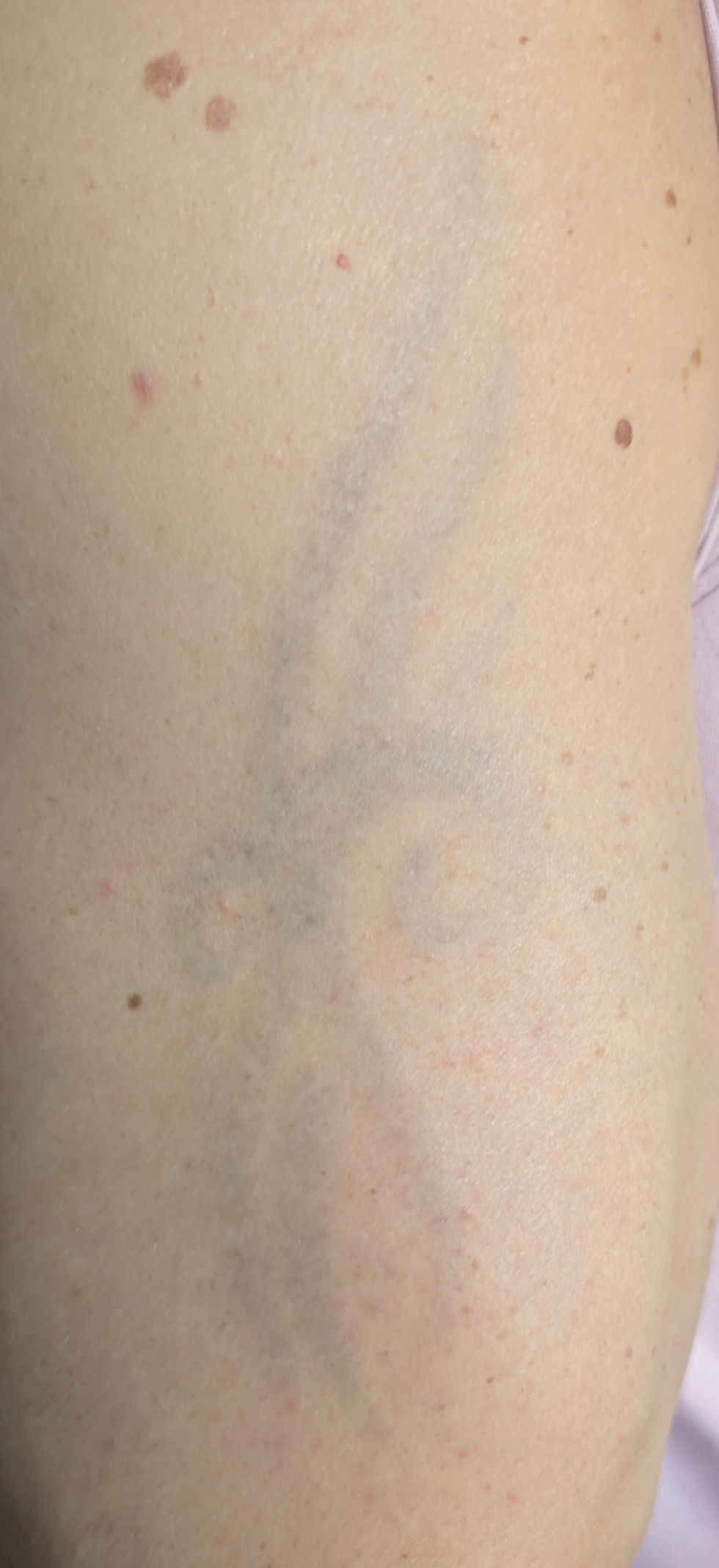
This gallery shows a variety of full removal, fading, patch-tests, SPMU and general progress photos.
How long it takes to remove a tattoo depends on: 1) How deep the tattoo is. 2) Fitzpatrick skin type. 3) Location of the tattoo on the body (closer to the heart, better circulation - quicker to fade). 4) tattoo colour (pastel colours are more difficult). 5) Saturation/density. 6) Hidden scarring/tissue damage from when the tattoo was originally done. 7) Layers of ink/cover-up tattoos. 8) How old the tattoo is (the older, usually the easier). 9) The patient's general health. 10) The patient's age (younger tend to have better immune systems).


(Click on the image to open)
These progress photos show you how the tattoo gradually fades. We don't always get a final photo as we don't see the client for the results after the final removal session!


Videos


Very recommend! 😊


Testimonials